

By Lotte Govaerts
(This post was originally published on the Rogers Archaeology Lab blog on October 10, 2017. You can see the original post archived here.)
This blog post is part of a series discussing my research on the historical archaeology of the River Basin Surveys (RBS). In my previous post I discussed the construction and impacts of Garrison Dam on the Upper Missouri in North Dakota. In this post I will discuss the name of the lake created by that dam, and the history of the woman it was named after. Like my last post in this series, this blog entry is also an edited version of a section of my recent paper on the transformative consequences of Garrison Dam (See Govaerts 2016 for the full version).
The reservoir created by the construction of Garrison Dam was originally referred to as Garrison Reservoir. Its name was eventually changed to Lake Sakakawea, after the Native woman who served as a translator on the famous expedition of Lewis and Clark. Sakakawea is the official spelling of her name in North Dakota, but other variations are used elsewhere, including Sacagawea and Sacajawea. There is some debate on the correct spelling, pronunciation and etymology of the name (see Anderson 1999). Because Sacagawea is the most common spelling, I use it here when referring to the person.
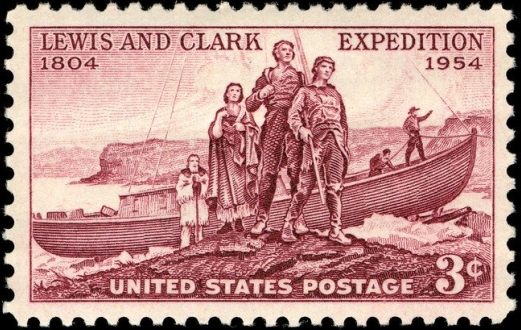
What do we know about Sacagawea?
Sacagawea was a Shoshone1 woman, born in the late 1780s in what is now northern Idaho. When she was around twelve years old, she was captured by a group of Hidatsa in a raid, and came to live in a Hidatsa village on the Upper Missouri. Sacagawea was later “married” to a fur trapper from Quebec named Toussaint Charbonneau, who lived among the Missouri River Indians.
Meriwether Lewis and William Clark, charged with exploring and establishing travel routes across the western lands acquired in the Louisiana Purchase, spent the winter of 1804-1805 at Fort Mandan, near the Hidatsa village where Sacagawea lived. The Corps of Discovery (the specially-created unit of the United States Army led by Lewis and Clark on their expedition) employed Charbonneau as a guide for the expedition. Upon finding out that his wives were Shoshone, they suggested he bring one of them as an interpreter:
a french man by Name Chabonah, who Speaks the Big Belley language visit us, he wished to hire & informed us his 2 Squars were Snake Indians, we engau him to go on with us and take one of his wives to interpet the Snake language. (William Clark’s journal entry for November 4, 1804)2
Thus Sacagawea and her newborn baby came to accompany the expedition. She is mentioned only intermittently in the Corps of Discovery’s journals.3 Usually on occasions where her actions directly impacted the progress of the expedition: Early on, she saved some precious supplies, including Clark’s journal and notes when a boat turned over on the river, Clark’s journal, May 14, 1805:
… about 6 oClock a Squawl of wind Struck our Sale broad Side and turned the perogue nearly over, and in this Situation the Perogue remained untill the Sale was Cut down in which time She nearly filed with water— the articles which floated out was nearly all caught by the Squar who was in the rear. This accident had like to have cost us deerly; for in this perogue were embarked our papers, Instruments, books, medicine, a great proportion of our merchandize, and in short almost every article indispensibly necessary to further the views, or insure the success of the enterprize in which, we are now launched to the distance of 2,200 miles.
…the Indian woman to whom I ascribe equal fortitude and resolution, with any person onboard at the time of the accedent, caught and preserved most of the light articles which were washed overboard.
(Lewis’ May 14 entry includes more information about the incident, but does not mention Sacagawea).
Shortly thereafter, Lewis and Clark named a tributary of the river for her:“this stream we called Sâh-câ-gar me-âh or bird woman’s River, after our interpreter the Snake woman” (Lewis, May 20, 1805).

When the expedition reached the area where Sacagawea grew up, she was familiar with the landscape:
the Indian woman recognized the point of a high plain to our right which she informed us was not very distant from the summer retreat of her nation on a river beyond the mountains which runs to the west … she assures us that we shall either find her people on this river or on the river immediately west of it’s source (Lewis, August 5, 1805).
Sacagawea’s family ties to the Shoshone they met there allowed for the purchase/trade of much-needed horses for the expedition: “The Great Chief of this nation proved to be the brother of the Woman with us and is a man of Influence Sence & easey & reserved manners, appears to possess a great deel of Cincerity.” (Lewis, August 17, 1805).
The anticipated need for horses to cross the mountains was the primary reason a Shoshone translator was included on the expedition. Lewis and Clark also opine in their journals that the presence of Sacagawea and her baby had a “calming” effect on various Native peoples they encountered, who might otherwise have been hostile: “The wife of Shabono our interpetr we find reconsiles all the Indians, as to our friendly intentions a woman with a party of men is a token of peace” (Clark, October 13, 1805).
From letters and other documents we know a little of her life after the expedition, and that she probably died at Fort Manuel in 1812 (Anderson 1976).

Legacy
Although little is known about Sacagawea’s life, she has become a popular figure in American History. The Lewis and Clark expedition is seen as an iconic event in US history, but during the 19th century, Sacagawea’s participation in it was rarely mentioned. This changed around the time of the expedition’s centennial celebration. The persona of a Native teenage girl who carried her infant along the perilous journey captured the public’s imagination. Early 20th century white feminists were among the first groups to celebrate Sacagawea’s story, which they appropriated in their fight for the vote. From its beginning, the myth of Sacagawea outshone what was known about the actual person. Sacagawea’s story, or some embellished version of it, was frequently the topic of books and movies throughout the 20th century. Over time, Sacagawea came to symbolize various ideas and concepts in dominant American culture such as manifest destiny or Native people’s innate ability to become “model citizens” as defined by white Americans.4
Although no contemporary portraits exist of her, there are more statues of Sacagawea in the United States than of any other woman, including one in the United States Capitol (Summit 2008, p. 109). In recognition of Sacagawea’s role in United States history, the United States Postal Service issued a Sacagawea stamp in 1994. The United States Mint issued a Sacagawea dollar coin in 2000. Many landscape features besides the Garrison Dam reservoir are named after her.

The lake’s name change
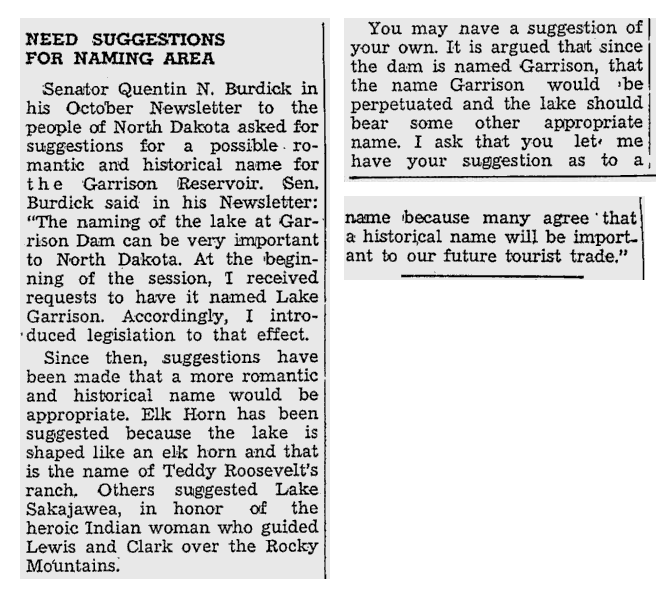
The idea of changing the name of the Garrison dam reservoir to commemorate Sacagawea was discussed as early as May 1955 at the North Dakota Federation of Women’s Clubs meeting in Bismarck (O’Brien 1955). Other groups and associations were also in favor of the name change, and the name was commonly used long before it became official in 1967. On July 4 of that year, Public Law 90-46 “An Act authorizing the change in name of certain water resource projects under jurisdiction of the Department of the Army” (United States 1968, p. 112) was signed, officially changing the name.
Now that we’ve explored some of the history of Garrison Dam and Lake Sakakawea, in our next installment in this blog series, we’ll look at some of the archaeological sites investigated by the River Basin Surveys in that area before the dam was constructed.
1. Sacagawea was born to a band of northern Shoshone called the Agaideka or “Salmon-eaters”. Later in the nineteenth century this band, along with the Tukudeka (Mountain Sheep-eaters) and Kusundica (Bison-eaters) would become known as the Lemhi Shoshone (see Campbell 2001).↩
2. All text from the Corps of Discovery journals quoted here is from the University of Nebraska – Lincoln’s Electronic Text Center’s transcription. This transcription retains original spelling and capitalization as much as possible (see https://lewisandclarkjournals.unl.edu/item/lc.about.faq).↩
3. For an overview of what is known about Sacagawea’s (and Toussaint Charbonneau’s) life, see Nelson (2003).↩
4. For a detailed study of the Sacagawea myth, its genesis and evolution, see Kessler (1996).↩
References:
Amon Carter Museum of American Art, “Remington and Russell, http://www.cartermuseum.org/artworks/339, accessed October 10, 2017.
Anderson, Irving W. “Fort Manuel, Its Historical Significance.” South Dakota History 6, no. 2 (1976): 131–51.
Anderson, Irving W. “History Commentary – The Sacagawea Mystique: Her Age, Name, Role, and Final Destiny.” Columbia Magazine 13, no. 3 (1999).
The Billings County Pioneer, “Need Suggestions for Naming Area,” October 25, 1962.
Campbell, Gregory R. “The Lemhi Shoshoni: Ethnogenesis, Sociological Transformations, and the Construction of a Tribal Nation.” The American Indian Quarterly 25, no. 4 (2001): 539–78.
Govaerts, Lotte E. “Transformative Consequences of Garrison Dam: Land, People, and the Practice of Archaeology.” Great Plains Quarterly 36, no. 4 (December 30, 2016): 281–308.
Kessler, Donna J. The Making of Sacagawea: A Euro-American Legend. Tuscaloosa, Ala.: University of Alabama Press, 1996.
Lewis, Meriwether, William Clark, et al., The Journals of the Lewis and Clark Expedition, ed. Gary Moulton, University of Nebraska Press / University of Nebraska-Lincoln Libraries-Electronic Text Center, Lincoln, 2005.
Nelson, W. Dale. Interpreters with Lewis and Clark: The Story of Sacagawea and Toussaint Charbonneau. Denton, Texas: University of North Texas Press, 2003.
O’Brien, Harry, “Short Stops”, Walsh County Press Park River North Dakota, May 19, 1955,.
Spier, Leslie, and Edward Sapir. Wishram Ethnography. Seattle, Wash.: University of Washington Press, 1930.
Summitt, April R. Sacagawea: A Biography. Westport, CT; London: Greenwood Press, 2008.
United States, United States Statutes at Large Containing the Laws and Concurrent Resolutions Enacted During the First Session of the Ninetieth Congress of the United States of America 1967 and Reorganization Plans, Twenty-Fifth Amendment to the Constitution, and Proclamations, Volume 81 in one part, United States Government Printing Office, Washington, 1968).




1 Comment
Add Yours →[…] the most recent installments in this series (here and here) I discussed the construction of Garrison dam and its ecological and social impacts. In earlier […]