
By Lotte Govaerts
(This post was originally published on the Rogers Archaeology Lab blog on September 24, 2018. You can see the original post archived here.)
I recently returned to the lab, after having spent most of my summer in Belgium. I have settled back in, and picked up where I left off back in June. Among other things, I have resumed work on the cataloging project I begun in late 2017.
You might recall we very excitedly announced completion of the Larson cataloging project (39WW2), last summer. By finishing work on Larson, we completed a multi-year cataloging project that also included collections from three other sites. At the time we believed that these were the last uncataloged River Basin Surveys collections from the northern Great Plains. We soon discovered that that wasn’t entirely true when collections staff alerted us to the presence of the partially cataloged Medicine Crow (39BF2) collection. Molly Coxson, a museum specialist, worked on this project some years ago, near the end of her time here at the National Museum of Natural History. She made great progress, but after her departure the project remained in stasis until we picked it up again late last year.

Medicine Crow (39BF2) is a complex, multi-component site in Buffalo County, South Dakota. It includes Plains Village as well as Archaic components. The Plains Village components have been assigned to the Talking Crow Phase of the Post-Contact Coalescent Variant of the Coalescent Tradition (Lehmer 1971, p. 201-202). Lehmer dates the Talking Crow Phase to A.D. 1700–1750. In a later analysis of Arikara ceramics, James Deetz identified three Plains Village Tradition components at Medicine Crow, dating 1690–1720, 1720–1750, and 1750–1780 (1965, p. 39). Archaic occupations at Medicine Crow date to the Early Archaic (7000–8000 BP), Middle Archaic (5000–7000 BP), and Late Archaic (3000–5000 BP) (Ahler and Toom 1989). The site was investigated by River Basin Survey crews over the course of three field seasons between 1956 and 1958. Harold Huscher, William Irving, and James Deetz each directed the project for a season.

The Medicine Crow collection contains the same types of artifacts as Larson and the other sites we previously reported on here on the blog (here, here, here, and here). The cataloging process is also much the same as previously described. One major difference is that the objects in this collection had already been assigned SI numbers when the previous crew worked on this project, and that some objects had already been given labels, and had their data entered into the Smithsonian cataloging system. Additionally, all of the material had already been transferred to updated housing. My first steps were to match the rest of the objects with the correct numbers, create a large spreadsheet with all data pertaining to each artifact number, and print artifact labels. After matching each object or lot of objects with its artifact label, I moved on to the process of physically numbering objects. Numbering is always a slow process, and I’m currently working on this project by myself on one, or at most two days a week as I combine cataloging with my other duties. This means that this stage of work will be ongoing for some time, but I will post relevant updates to our blog as the work progresses.
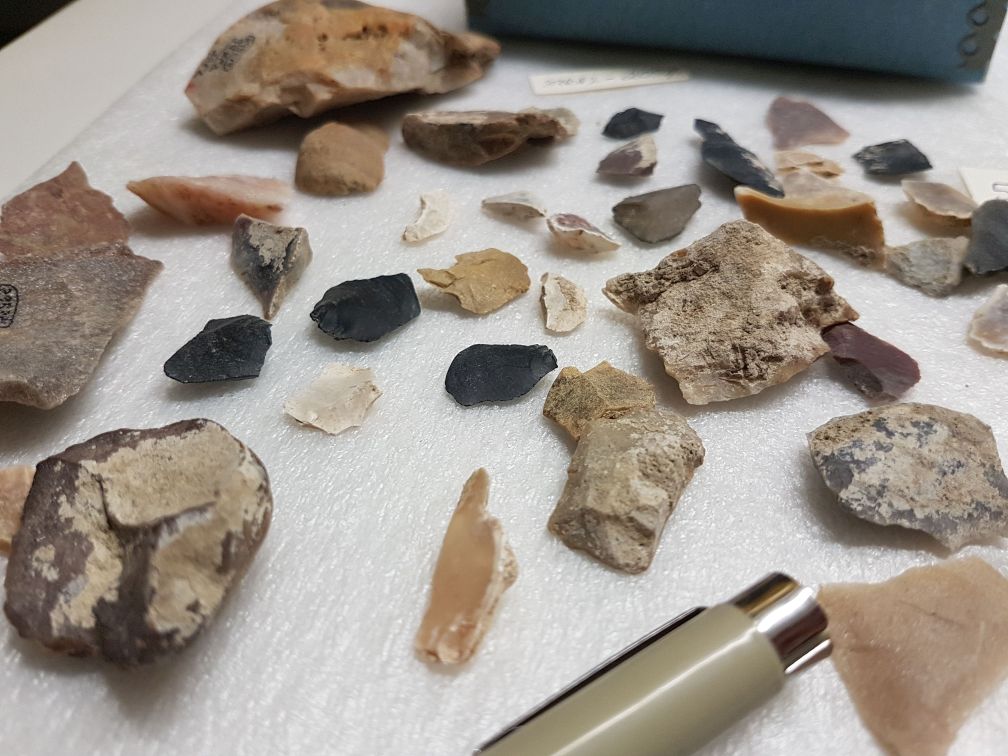

I have been moving through drawers in numerical order, and I’m currently working on a set of drawers that contain lithic material from an Archaic site component. What is interesting about these drawers is that they contain a large amount of lithic debitage (debris generated during the making of stone tools), which we did not see in the other collections we cataloged. There were some lots of “stone samples” in the Larson collection, but for the most part the previously cataloged collections contained fully or partially finished tools, not the debitage generated in the making of the tools. Soil was screened during the excavation of these areas of 39BF2, which means that there are some rather small flakes in these lot numbers. This calls for some very small handwriting, and is making the numbering process take a bit more time than it does for drawers with larger objects. On the plus side, the smooth writing surface on most of these flakes makes the numbering pens last much longer than they do when there’s large lots of potsherds to be numbered!

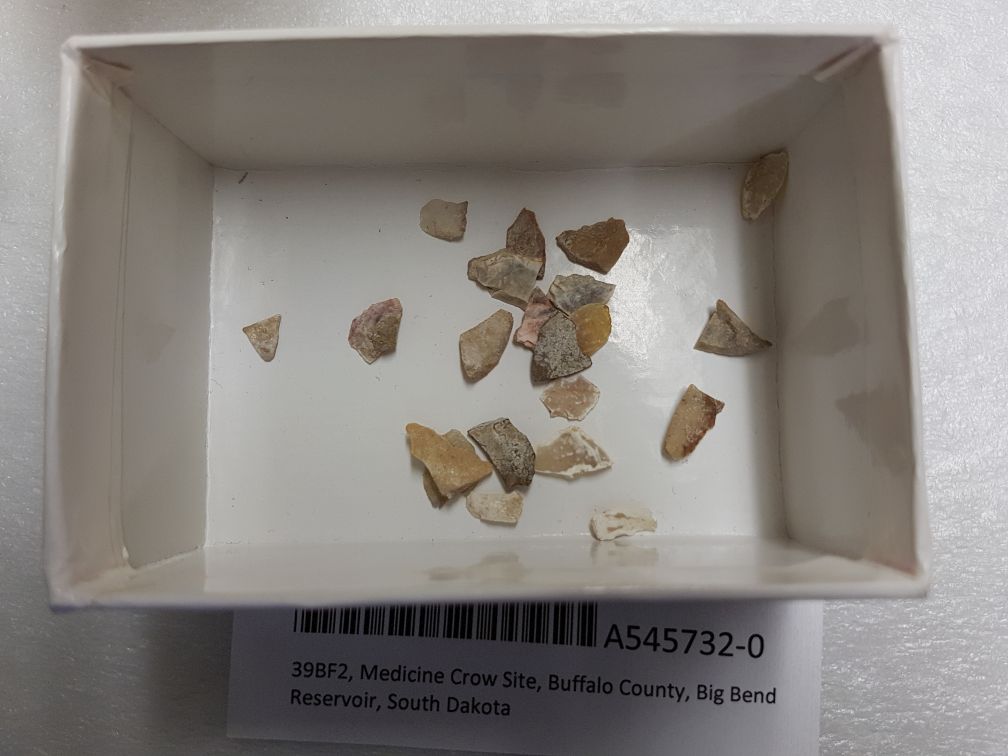
I look forward to sharing more updates about the Medicine Crow cataloging project in the future, so stay tuned!
References Cited:
Ahler, Stanley A., and Dennis L. Toom (eds.). 1989. “Archeology of the Medicine Crow Site Complex (39BF2), Buffalo County, South Dakota.” A report prepared in partial fulfillment of Contract No. CX 1200-6-3547 (originally Contract No. CX 1595-6-0010) by Illinois State Museum Society for the Rocky Mountain Regional Office, U.S. National Park Service. Denver, CO: Branch of Interagency Archeological Services, U.S. National Park Service, Rocky Mountain Regional Office.
Deetz, James. 1965. The Dynamics of Stylistic Change in Arikara Ceramics. University of Illinois Press.
Lehmer, Donald J. 1971. Introduction to Middle Missouri Archaeology. Anthropological Papers 1. Washington, D. C.: National Park Service.




2 Comments
Add Yours →[…] Cataloging the Medicine Crow Site (39BF2) […]
[…] Cataloging the Medicine Crow Site (39BF2) […]